

 |
FALLEN TIMBERSCol. N.B. Forrest & Terry’s Texas RangersBattle of Shiloh - April 8, 1862 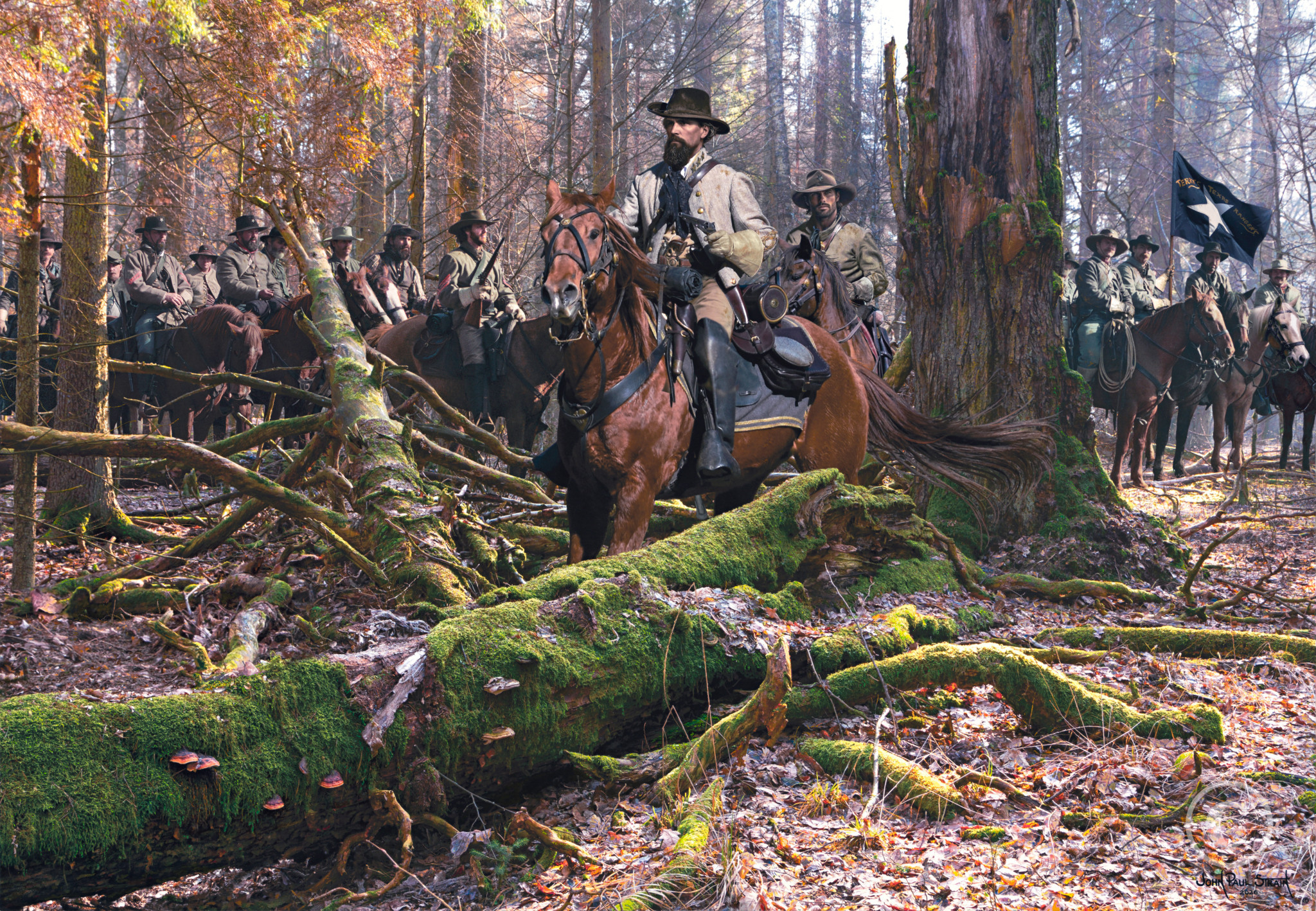
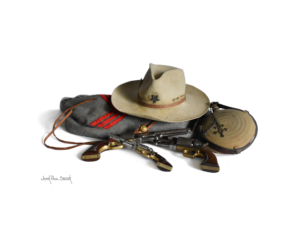
Fought in southwest Tennessee, the Battle of Shiloh would be one of the first major and bloodiest battles of the Civil War. At Pittsburg Landing, Tennessee, General William T. Sherman described the weather in a letter dated April 3, 1862, saying it was “springlike … apples and peaches in blossom and trees beginning to leaf, bluebirds singing.” On April 6, Confederate forces under the command of General Albert Sidney Johnston launched a surprise attack at dawn against Union forces around Pittsburg Landing on the Tennessee River. The southerner’s attack was devastating and successful. Although General Johnston had been killed in his charge through the “Peach Orchard”, General Grant’s troops were beaten, taking up a final defensive line near the river. Now in command, General P.G.T. Beauregard and his generals that night made battle plans to finish off Grant’s army the next morning. Unknown to them, they would face a new force of 18,000 fresh troops of the Army of the Ohio under the command of General Don Carlos Buell, who would reinforce union troops hunkered down during the rainy night. When Confederate forces attacked the following morning they soon realized they were facing a new foe. With fresh reinforcements, Grant launched a counterattack. Outnumbered and exhausted, the Confederates withdrew towards Corinth, Mississippi. Colonel Nathan Bedford Forrest was assigned the task of covering the retreating southern army. Forrest commanded a small rear-guard force of 220 Terry’s Texas Rangers, 40 of his personal escort, and 40 Mississippians. General Grant sent Sherman southward on a reconnaissance to gauge whether the Confederates were retreating or reorganizing. When Sherman’s advance guard emerged from woods near a clearing of downed timber, Forrest and his Rangers unexpectedly wheeled and charged straight into the Union line. His sudden attack scattered the federal horsemen, but Forrest rode too far ahead of his troops and was shot point blank by a passing federal cavalryman with a .54 caliber carbine. The bullet passed though his left hip and lodged near his spine. Despite his serious injury, Forrest fought his way out of the engagement and rejoined his troops. Forrest’s charge made Grant and Sherman pull back and abandon any idea of pushing the retreating Confederates. In Sherman’s official report (OR, Series I, Vol. 10) “The enemy’s cavalry came down upon us at a charge…and we were compelled to fall back. I became satisfied the enemy was in too great a force for further pursuit.” Colonel Forrest’s ferocious counter-charge at Fallen Timbers became legendary. Forrest and his Rangers had preserved the Confederate withdrawal towards Corinth. It contributed greatly to Forrest’s reputation as the most successful and aggressive cavalry commander of the war. Artist’s Note: Terry’s Texas Rangers had a number of distinctive features. The Texans wore wide brim soft felt slouch hats in black, brown, or sand-gray, often creased Texas-style (pinched front or center crease). On their hats they wore a silver star cut from a Mexican Peso. Corporals and sergeants wore red worsted chevrons, (not the regulation yellow). Rangers were famous for excellent well trained Texas horses, generally taller, leaner, and faster than enemy mounts. Rangers were heavily armed, more so than typical southern cavalrymen, with multiple revolvers, shotguns, and carbines. Forrest fit right in with the Rangers as he also carried multiple pistols. Captain David Kelly of Forrest’s Escort recalled, “The General went into a fight with more pistols than any man I ever knew.” His men would joke, “The Colonel never runs out of shootin’ irons - he just keeps pullin’ out another." Archival Paper Giclées
Canvas Giclées
|  |

 |
SHARE THIS SITE: |
All Illustrations - Copyright© 2001-2021 by JOHN PAUL STRAIN TM - All rights reserved. No part of the contents of this website may be reproduced or utilized in any form by any means without the written consent of the artist. |
817.560.2143
Contact Us |