

 |
STONEWALL OF THE WESTMajor General Patrick R. CleburneMcCutcheon Creek - Near Spring Hill, TN. November 30,1864 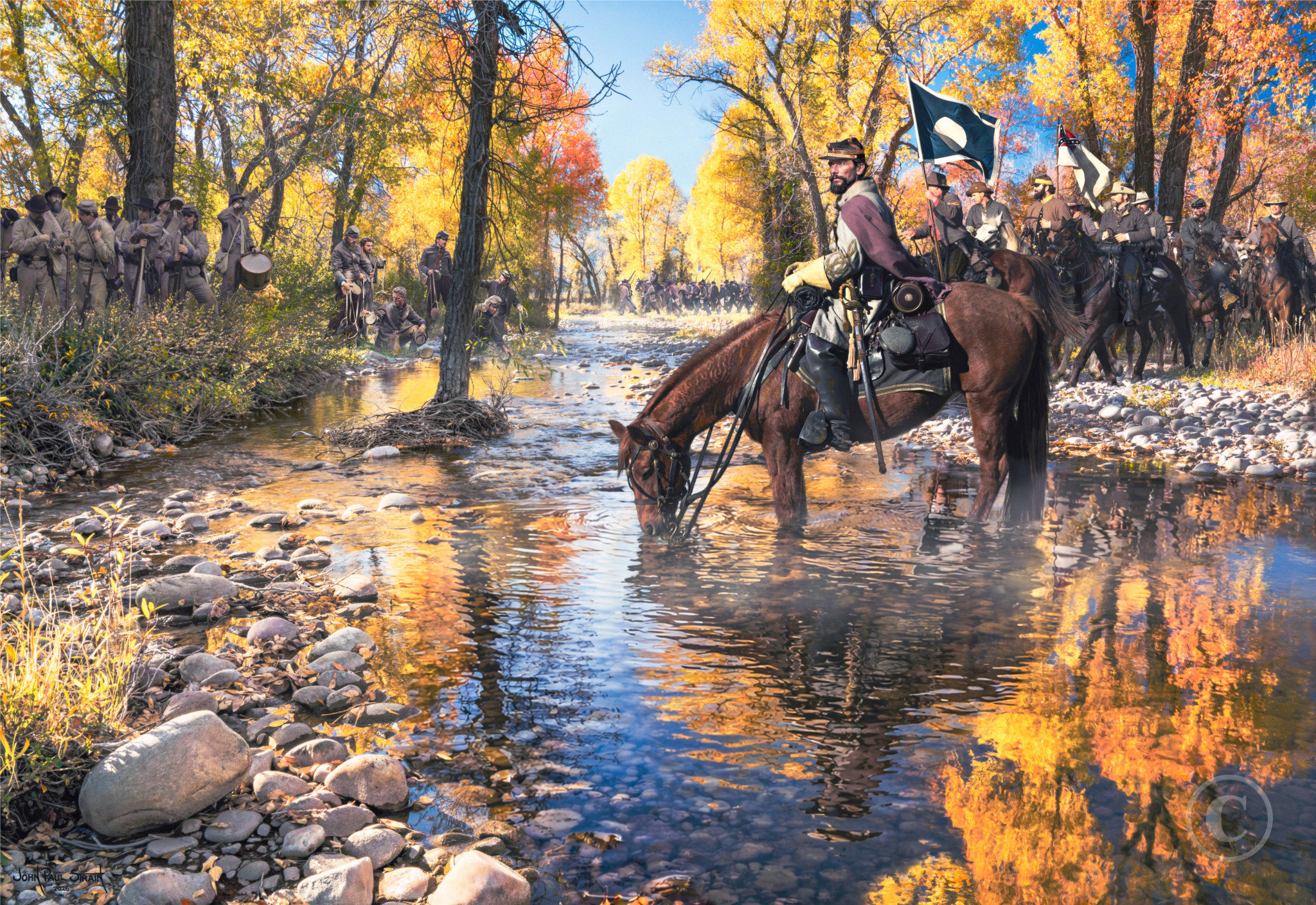
Patrick Ronayne Cleburne was born March 17, 1828, in County Cork, Ireland, and immigrated to the United States at the age of twenty-one in 1849. Before the war, he lived in Helena, Arkansas, where he worked as a pharmacist and later became an attorney. When the war broke out, he joined the Yell Rifles, a local company, serving as an officer in the Arkansas militia. Southern by choice, he was loyal to his adopted home and its people rather than ideology. His Irish brogue was distinctive and respected by his troops. Cleburne's leadership and battlefield performance at Shiloh, Perryville, Stones River, Chickamauga, Missionary Ridge, and Ringgold Gap earned him a reputation as one of the best commanders in the army. Cleburne and Nathan Bedford Forrest were friends in the way hard-fighting professional soldiers become friends, through mutual respect, shared danger, and confidence in each other’s judgement. Both men admired the other’s battlefield ability. Cleburne admired Forrest’s speed of decision, instinct for terrain tactics and aggressiveness. Forrest, in turn, respected Cleburne as the Army of the Tennessee’s most reliable infantry commander, one who could be trusted to hold ground or break through enemy positions when required. Morning temperatures on November 30th had dropped near freezing, with frost covering the ground and mist rising from McCutcheon Creek as General Cleburne and his troops watered their horses and filled canteens for the day ahead. Cleburne’s Division, part of Cheatham’s Corps, was under orders from General Hood to resume the northward march in an effort to overtake US General Schofield’s retreating army. Marching along the Columbia Pike, the men were tired but steady after a sleepless, cold night. The column moved a a measured, businesslike pace. News soon filtered back the Schofield’s army had slipped past Spring Hill in the night. Orders emphasized speed and cohesion, rather than minor skirmishing, and Cleburne kept his division tight and disciplined, avoiding unnecessary straggling. By late morning and into midday, as the division approaching Franklin, the terrain open up and the pike rose toward Winstead Hill, south of town. Cleburne’s division moved into position with Cheatham’s Corps. From the heights, officers could see that the Union troops were no longer retreating but were digging in forming strong defensive lines. It became clear the Federals intended to stand and fight. After reconnoitering the position, General Forrest and his scouts found the Federal works were well constructed with ditches, parapets, and strategically placed artillery. Forrest advised Hood of the strength of the position and urged a maneuver, suggesting a flank or rear attack using his cavalry supported by infantry, against the Federal left flank. Forrest expressed concern about Hood’s plan for a frontal assault. Hood rejected this advise and ordered preparations for a direct, massed attack on the Federal position. A long, tense wait followed as Hood’s divisions dressed their lines. Staff officers conferred quietly while soldiers adjusted their cartridge boxes and checked their muskets. General Cleburne rode among his brigades, calm, direct, and unsentimental. Under Hood’s orders, the Confederate line stepped off at about four o’clock in the afternoon, advancing directly into the Federal defenses. The fire was devastating. Confederate casualties in the assault at Franklin exceeded those of Pickett’s Charge at Gettysburg, making it the most costly frontal attack ever undertaken by Confederate infantry. Six Confederate Generals were killed outright: Patrick R. Cleburne, John Adams, Otho F. Strahl, Hiram B. Grandbury, John C. Carter, and States Rights Gist. No other single battle in American history saw so many generals killed on one side in a single engagement. Most were killed within yards of the Union works leading their troops forward. Their deaths devastated the leadership of the Army of the Tennessee and contributed directly two weeks later during Hood's failed attempt to reclaim Nashville. General Cleburne, known to his men as the “Stonewall of the West” was the Army of the Tennessee’s most dependable infantry commander. He was a leader of iron resolve, tactical brilliance, and unyielding personal courage. Archival Paper Giclées
Canvas Giclées
|  |

 |
SHARE THIS SITE: |
All Illustrations - Copyright© 2001-2021 by JOHN PAUL STRAIN TM - All rights reserved. No part of the contents of this website may be reproduced or utilized in any form by any means without the written consent of the artist. |
817.560.2143
Contact Us |