

 |
MCNEILL’S MOUNTAIN RANGERSLt. Isaac S. Welton, Sgt. Joseph W. Kuykendall, Sgt. Joseph L. VandiverSouth Branch Mountain Near Romney - February 22, 1865 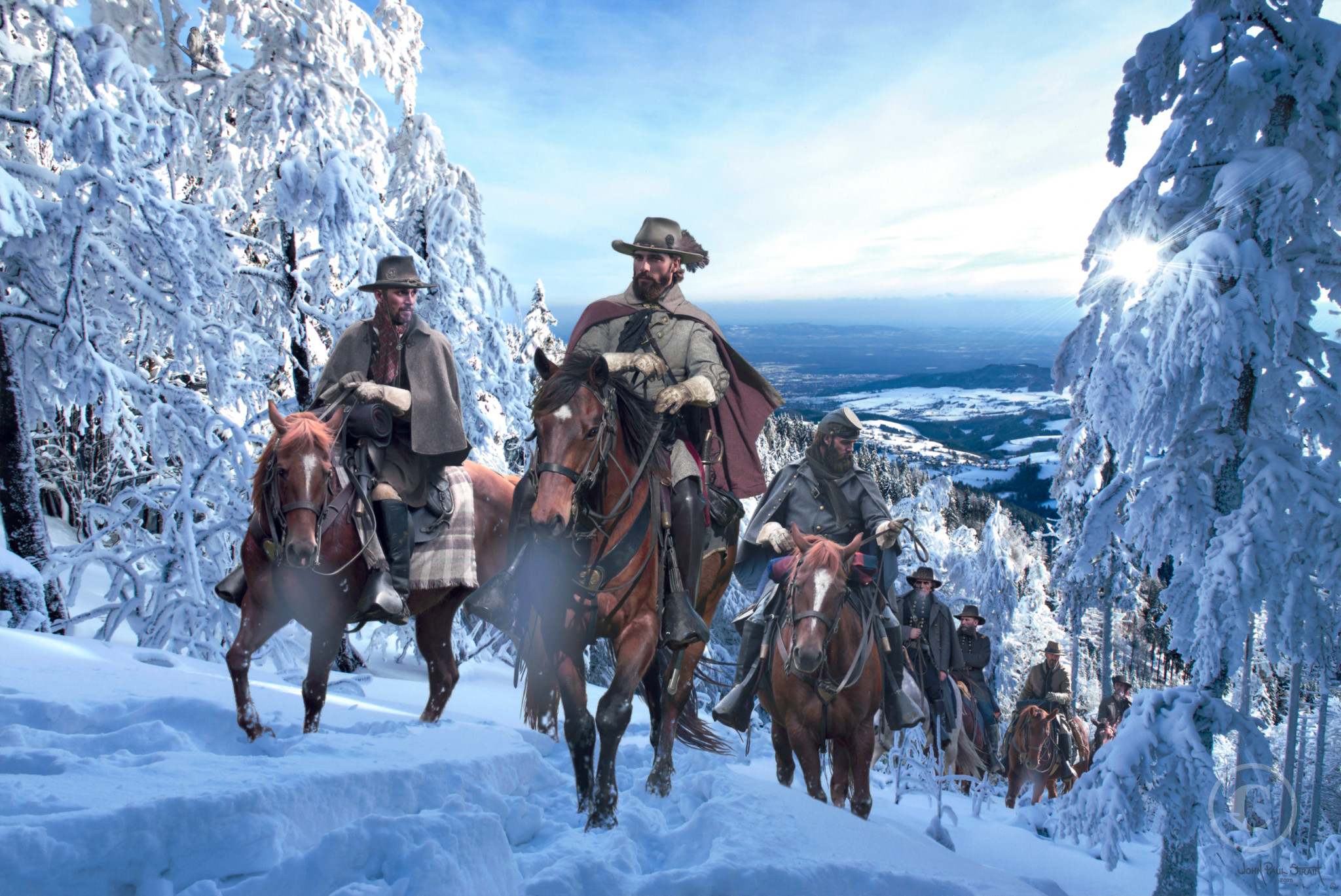
Before the war, the men in and around Hardy County were hunters. These men were expert woodsmen, hunting and trapping in the mountains of western Virginia. They knew every game trail and pathway throughout their mountains and valleys. But now as their beloved homeland had been invaded by an army from the north, these mountain men would use their skills hunting men rather than game animals. For over two years McNeill’s Rangers was one of the most effective Confederate cavalry units operating in Virginia. Their targets were Union supply trains, supply depots, the B & O Railroad, and anything of value to the invading army. After a successful Ranger raid, US General Imboden describes why no Rangers were captured in his official report. “Captain McNeill took to the mountains, and by a wonderful march (for rapidity) escaped, though pursued by over six hundred men.” The year of 1863 had been one of immense success for the Partisans of the South Branch Valley. Though the Rangers were relatively small in numbers, their exploits causes havoc in the ranks of the Union Army. Their daring hit and run raids resulted in tremendous damage to the Federal war machine. In response to the raids the Federals deployed thousands of troops to protect the Baltimore and Ohio Railroad from the Ranger raids. On a raid in January 1864, the Rangers captured a wagon train near Williamsport and confiscated arms and equipment, including 3,000 pounds of bacon. They then burned what was left of the supplies, and disappeared with a number of prisoners. Two days later they captured the town of Romney, holding it for three days. On this occasion, General Robert E. Lee had high praise for the Rangers, saying “You will find, I think, Captain McNeill bold and intelligent, and others in his cavalry (as well).” Perhaps the Rangers’ greatest feat was the seemingly impossible kidnapping of two Union Generals in what became known as "The Great Cumberland Raid”. On February 21, 1865 under the cover of night in a blinding snow storm, a raiding party consisting of forty-eight McNeill’s Rangers and fifteen well known men from other commands began their sixty mile ride. After crossing the Potomac River the raiders used an obscure route of twenty rugged miles over several mountain ridges, one of which was called the Nobly Mountain. The temperature was biting cold and snow drifts in many places made passage difficult for the horses. When the Rangers arrived near the town of Cumberland it was still dark. Even though Cumberland was occupied by a Union garrison of over 10,000 troops, the Rangers managed to bypass pickets and guards by posing as Union soldiers. With the help of an informant they went straight to hotels of the Revere House and Barnum House to find their targets of Brigadier General Kelly and Major General Cook in bed. The captured generals were taken without a fight and the Rangers escaped with them. There was no time to tally, as the raiding party was heading for home at a fast pace. Just four miles out of the city the boom of a cannon echoed through the mountains as the alarm was sounded. Soon Union cavalry was in pursuit and the chase was on. Their route took them back across the Potomac River into western Virginia and up into the South Branch Mountains. They navigated steep snowy heavily forested terrain using lesser known paths to evade the Union pursuers. Outside Romney the Federal cavalry from Cumberland caught up. A brief exchange of gunfire erupted, and the boys in blue retreated. Upon reaching the Moorefield valley, the Rangers were again intercepted. A whole brigade of the Ringgold cavalry from New Creek suddenly appeared on the opposite bank of the river. With their horses almost played out the Rangers made their way up again into the mountains, following the hunting trails they knew so well. Describing the raid General John B. Gordon said, “in Daring and dash it is the most thrilling incident of the entire war.” Colonel John S. Mosby (Mosby’s Rangers) extended his hand in congratulations to Lt. Welton and said, Archival Paper Giclées
Canvas Giclées
|  |

 |
SHARE THIS SITE: |
All Illustrations - Copyright© 2001-2021 by JOHN PAUL STRAIN TM - All rights reserved. No part of the contents of this website may be reproduced or utilized in any form by any means without the written consent of the artist. |
817.560.2143
Contact Us |